Wealth Digital
Account Opening
2023 - Present · Goldman Sachs
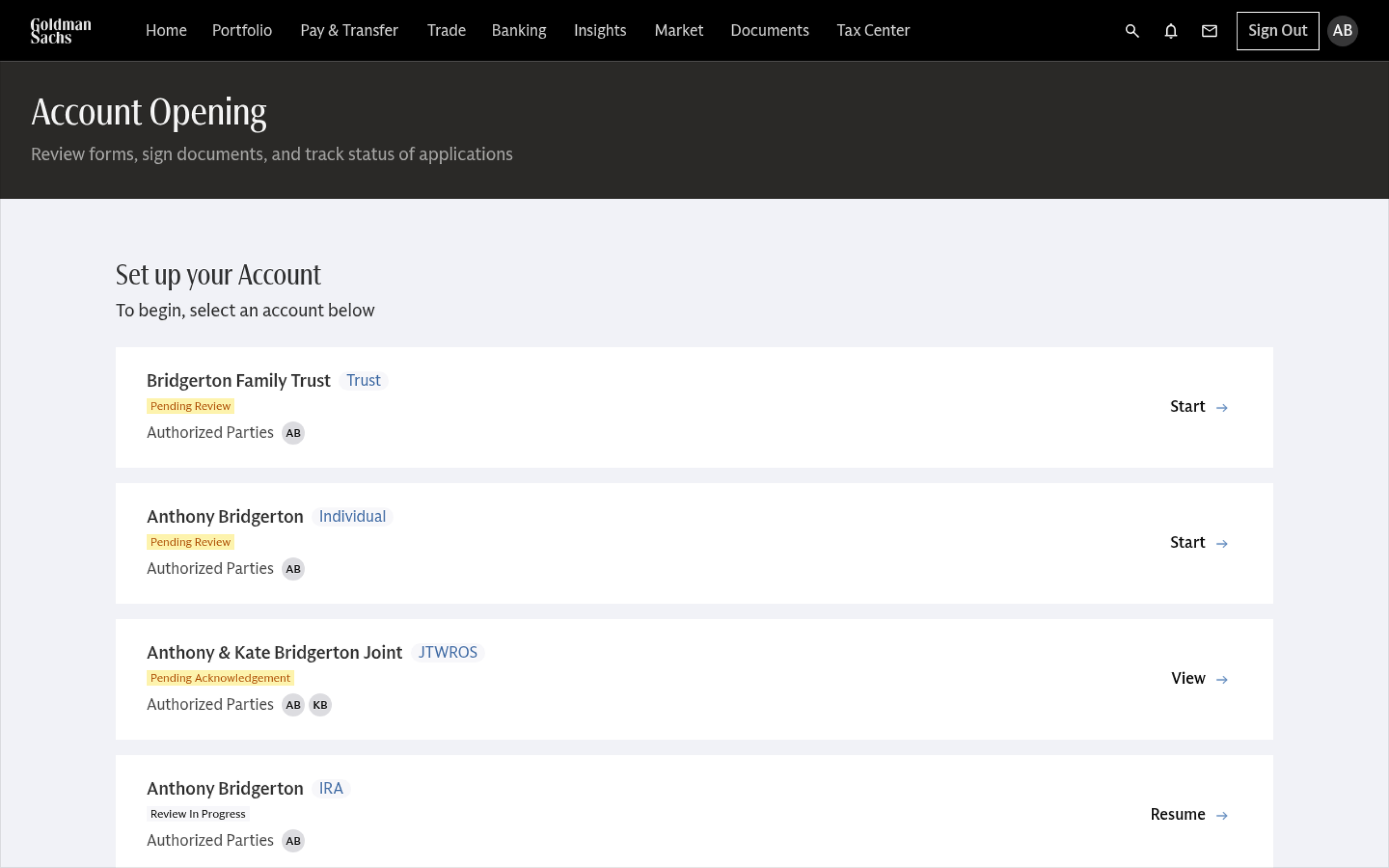
80% of application forms return with client edits which sometimes result in application errors.
Operations spends ~30 minutes re-keying changes into the database.
The re-key process and application errors create delays in opening an account.
Challenge
Goals
Reduce days-to-onboard.
Reduce the number of applications returned with errors.
Eliminate Operations re-key (~80% of applications).
Improve mobile usability for clients.
Role
Lead design execution and delivery across the advisor and client experiences.
Built and maintain the program's Figma component library and an AI conversion skill.
Co-run usability studies.
Background
- AdvisorFills out paper forms with the client
- ClientSigns the forms by hand
- AdvisorScans or mails the packet to Operations
- OperationsReviews the packet and keys the data into systems
- OperationsSends back anything missing or incorrect, and the loop repeatsRework
Paper Process
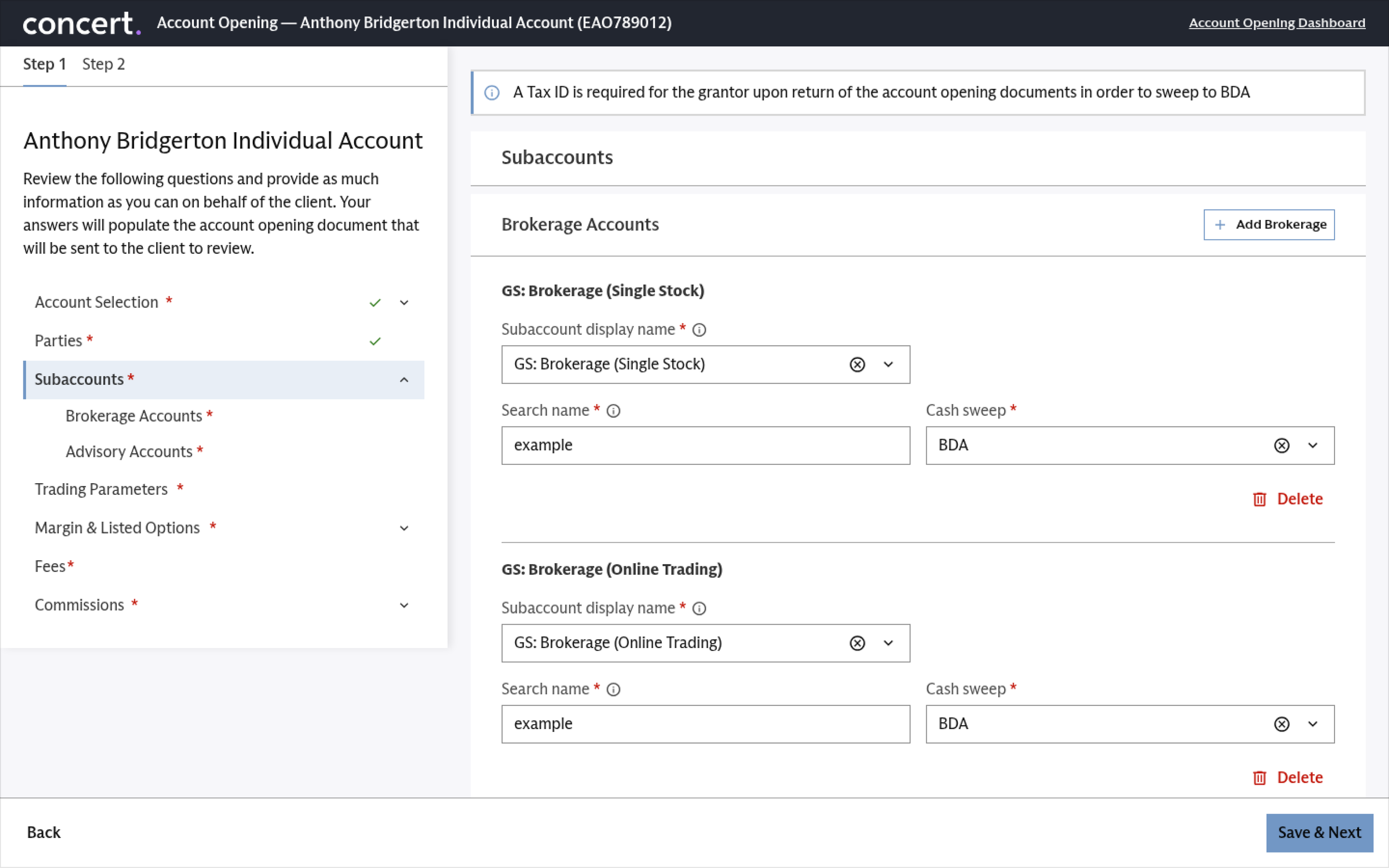
- AdvisorCompletes the application online in the advisor platform
- AdvisorGenerates a DocuSign document for the client
- ClientReviews and signs. About 80% of applications get edits made in the document, averaging 8 fields
- OperationsRe-keys the client's edits, about 30 minutes each, and every correction adds daysRework
- OperationsProcesses the application and opens the account
Legacy Digital Journey
New Digital Journey
Currently supports U.S.-based Trust, Individual, Joint accounts
- AdvisorCompletes the application in the advisor platform
- AdvisorSends the client a link to review their information
- ClientReviews and edits their information directly. The system validates as they go
- ClientSigns electronically
- OperationsReceives structured data, so there is nothing to re-key
Advisor Experience
Ayco Client Analysts (CAs)
PWM Wealth Management Professionals (WMPs)
Users

Testing & Validation
-
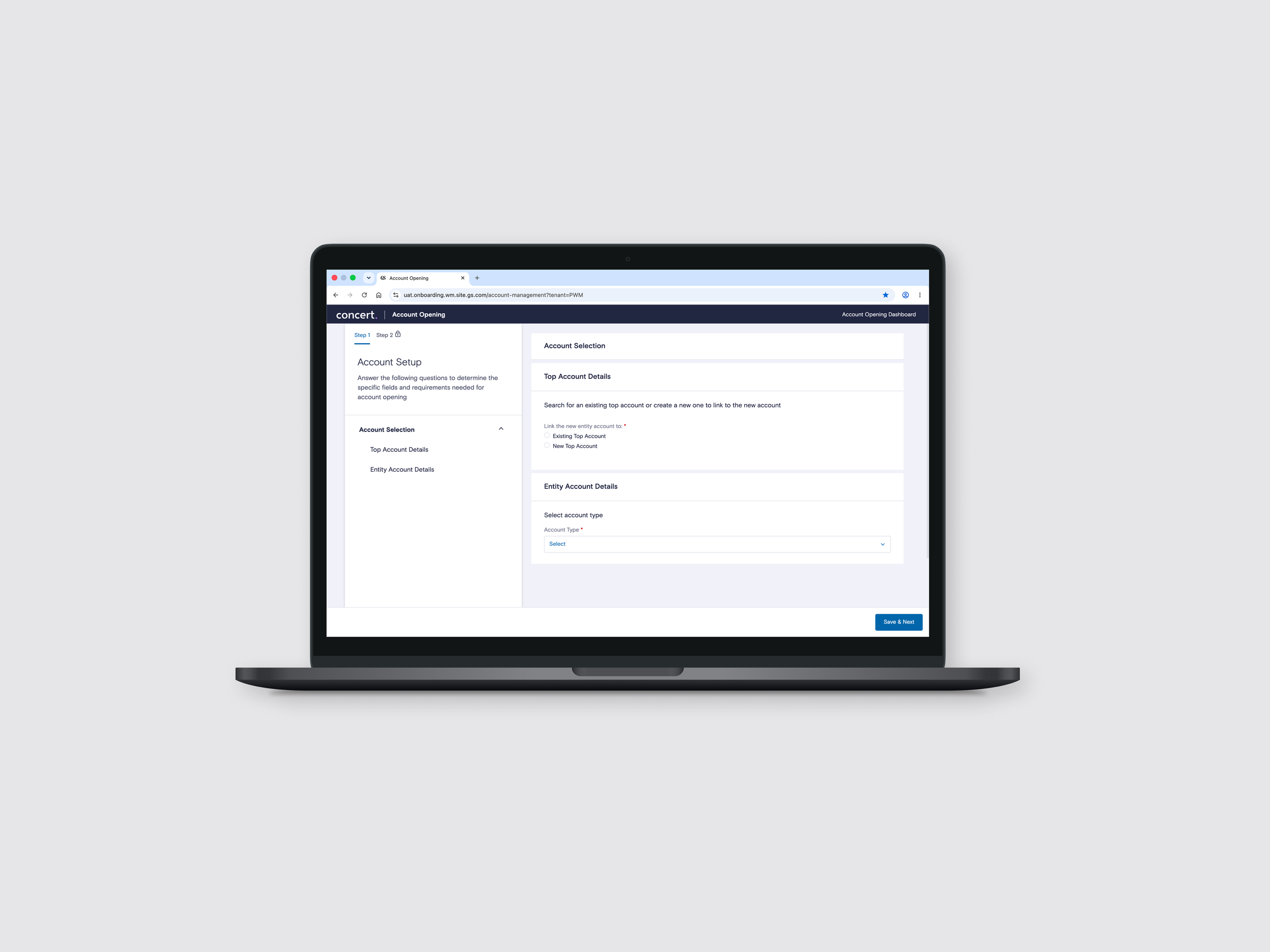
Observe 6 brand new Ayco users walk through the advisor journey and ask them to rate their experience.
Methodology
Moderated usability testingRatings
Form usability: 4.7/5
Navigation: 4.7/5
Independent completion: 6/6
Overall: 4.5/5
What needs iteration
Parties CTA: 4/6 took unintended first action
Approval transition: 4/6 thought they were finished
Trust alert: 2/3 misunderstood messagingKey Takeaway
Verbiage could be improved to make the sequence and instructions more clear but overall users were able to successfully complete the flow without intervention. -
The document approval process done by Operations that resulted in a 2-step/tab linear flow was eliminated in June 2026. Now, users can use a custom AI that is integrated into the flow to extract data from trust documents which they would then verify. Hence, there was considerable feedback to re-order the navigation and combine everything into 1 step/tab.
Methodology
Card Sorting with 8 participants (4 Ayco, 4 PWM)Key Takeaway
Users felt strongly that: party data pages should immediately follow party and role selection; pages should be grouped and labelled to maintain digestibility while providing context. Re-ordering pages will require a phased approach due to engineering effort associated with re-working the logic.
“You can do it without having a guidebook, it guides you itself. I really like this tool, I wish I could use it for all accounts!””
Initial Design Decisions
Honor the paper document pagination
Explain design decision that came as the result of the client user tests
Split up the flow into 2 linear steps
Explain design decision that came as the result of the client user tests
Iterations
Doc AI Integration
Re-design after doc AI
L&C requirements for human in the loop
Turn 2 tabs into 1
Before and after shot of navigation
Launches & Metrics
Timeline
- Jun 9, 2025Ayco Trust pilotFirst production release of the advisor experience, for Trust accounts in Newport Beach
- Q3–Q4 2025Stabilization and expansionFixed production findings and moved Individual and Joint accounts through testing
- Jul 31, 2026PWM pilot, phase 1Individual, Joint, and Trust accounts with six advisors in six offices
- Aug 31–Sep 4, 2026PWM pilot, phase 2Pilot grew to 36 users across 13 offices
- Sep 30, 2026PWM broad launchWave 1 opened to all advisors in the Los Angeles office
- Oct–Dec 2026Phased expansionAtlanta and Boston added, with more offices through year-end. 58 accounts opened by early November
Days to open applications
Applications returned with errors
Next Steps
-
As of early November, 40 of 58 opened accounts (about 69%) had a logged NIGO. Sorting the reasons: 17% already fixed, 29% Operations errors or false positives addressed through communication and training, and 55% tied to future product enhancements.
Once the client experience launches, it will be helpful to observe how usability improvements contribute to fewer client errors and thus fewer applications returned with errors.
-
Integrating notifications into the advisor dashboard where they currently view status across all their in-flight accounts will allow them to react faster to progress and blockers, which could lead to reducing the days to open an account.
-
By the end of Q4, the rebrand to the new firmwide design system should be live on the platform. This is an initiative I have been championing because it allows us to streamline the design to engineering workstream and thus to srategically expand to new account types and regions.
2027 is scoped for the following expansion:
U.S. account types:
Corporations, LLCsEMEA account types:
Individual, Joint, PIVs, Corporations
Design Systems
In Figma I built and maintained 33 product-specific component families spanning 607 variants, with the most complex family supporting 87 configurations—all composed from the existing foundational PWM design system. This library is used in 20+ files, the largest one of which contains XXX instances.
607
Component variants
33
Component sets
Files using these components
20+
-
1 component = 1 page of the flow
1 row of variants = 1 card on page
1 delivery file = All pages in the flow for that release
In each delivery file, 1 page contains all designs for a feature which can be covered by a few Jira stories.
Some components needed a layer of deeper nesting to allow for more efficient scenario modelling.
-
Field Group
State
Max Records
AI Powered Conversions
lorem ipsum dolor sit amet consectetur adipiscing elit dolore eligendi imperdiet fuga sed et nobis nulla ut exercitation nihil quos voluptas veniam corrupti nostrud soluta minus mollitia culpa mollitia est fugiat sint eu dolor dolor ea amet et cupiditate consequatur illum eu sit minus elit officia ut nobis ullamco nobis
Summary
After (One GS Design System)
Before (PWM Design System)
lorem ipsum dolor sit amet consectetur adipiscing elit dolore eligendi imperdiet fuga sed et nobis nulla ut exercitation nihil quos voluptas veniam corrupti nostrud soluta minus mollitia culpa mollitia est fugiat sint eu dolor dolor ea amet et cupiditate consequatur illum eu sit minus elit officia ut nobis ullamco nobis
Process
607
Component variants
33
Component sets
607
Component variants
33
Component sets
Reflections
-
The more complex a component, and the more instances of it that are used in a file, the more time it takes to sync changes to the instances when the main component is updated. This can be tedious to maintain especially if minor changes are made periodically.
To solve for this, next time I would either breakdown certain components further, e.g. “Converged PI”, and/or I would structure delivery files by feature as opposed to by release.
The one issue I forsee in having more delivery files is having more files to manually sync, which brings me to my next point—finding ways to automate syncing. -
Coded prototypes are beneficial for:
Effectively demonstrating interactions
Efficiently updating foundational elements of a flow
Socializing with stakeholders
Static mockups in Figma allow each step of a flow to be evaluated at a glance
-
Rules are necessary but they cannot be too rigid otherwise the system will be rendered unusable. This leads to more detached instances which makes maintaining libraries and updating design artifcats incredibly difficult.
-
Onboarding a new member to the team in early 2026 taught me that maintaining a library is just one piece of the puzzle. Creating (and maintaining) documentation that clearly communicates how a system should be navigated is what truly makes a system scalable. Relying on a designer’s intuition is not sufficient because we all have different mental models of how to organize assets.
-
Having powerful tools that can quickly take frames from static to interactive is empowering as a designer because it makes me a more holistic contributor. Getting to flex my coding skills to debug builds and understand how to build complex logic systems has also greatly improved my collaboration with engineering because I am getting closer to their work and can more clearly grasp the challenges and concerns they raise. But I also now have some more knowledge to gently push back on UX decisions that I feel should not be sacrificed by technical limitations.
Next Steps
AI-assisted visual QA
Explain
Client Experience
Users
Ayco: minimum $3 million investable assets
PWM: minimum $10 million investable assets
Current Experience
DocuSign
No business logic = more NIGOs
Explain
No central hub to track progress
Explain
Poor mobile usability
Explain
Research & Testing
-
Should missing data be collected upfront before reviewing the full form? Or should fields with missing data be highlighted as the user reviews the full form?
Methodology
InsertRatings
Insert
What needs iteration
InsertKey Takeaway
Insert -
Which interaction model best supports the chosen client data collection approach or highlighting missing data while reviewing the full form?
Methodology
InsertRatings
Insert
What needs iteration
InsertKey Takeaway
Insert -
Does the selected interaction model scale appropriately to mobile?
Methodology
InsertRatings
Insert
What needs iteration
InsertKey Takeaway
Insert
“You can do it without having a guidebook, it guides you itself. I really like this tool, I wish I could use it for all accounts!””
Key Design Decisions
Highlight incomplete required fields
Explain design decision that came as the result of this client user test
Mixed state cards, page-level save
Explain design decision that came as the result of this client user test
Decision from the mobile study
Explain design decision that came as the result of this client user test
Stakeholder Feedback
The copy debacle
Balancing UX best practices with L&C feedback
Some other piece of feedback
Explain design decision that came as the result of the client user tests
Reflections & Next Steps
-
Description
-
Description
Team
-
Maya Pruitt (Until June 2026)
Felicia Renelus (Since March 2026)
Until January 2024:
Trish Hannes
Lauren Blake
Arleigh Parr -
Shriya Paliwal
Sarah Li
Aditi Nawarney
Claude Mulindi
Justin Menasse
Arjun Mukherjee
Sarita Gahlot
Jillian Sussman
Sonia Janaqi
Harris Mevorah
Aditya VemugantiPre-2026:
Annie Zhang
Katie Han
Kunal Shah
Alex Gandhi
Charu Sankaraganesh -
Jakub Grabarczyk
Bhushan Pachpande
Naresh Kumar Kadari
Miguel Hernandez
Daron Dowd -
Alyssa Saumell
Colin Helwig
Laura Weicks
Will Garrett
Brock Bauer -
Jeremy Adler
Jena Rotheim
Jocelyn Ely